The Hidden Costs of Leaving a Monolith for Microservices
Roughly 85% of enterprises now run microservices somewhere in their stack. But 42% of those same organizations have already pulled at least some services back into larger deployable units. That gap between adoption and quiet reversal is the actual story here: migrating off a monolith carries a long tail of cost, most of it invisible at decision time, and understanding that tail is what separates a migration that pays off from one that just drains the budget slowly enough that nobody notices until year two.
How teams end up deciding to migrate, and why that decision process is usually flawed
Most migrations don't start with a strategy document. They start with pain.
The monolith crashes during a traffic spike, or a merge conflict eats more hours than the feature it was blocking would have taken to write from scratch. That's trigger one, and it's reactive by nature: something broke, so the assumption becomes that the architecture is the thing that's broken.
Trigger two is subtler but just as common. Teams find they can't ship a small change without breaking something unrelated three services away. QA cycles stretch out, hotfixes pile on top of hotfixes, and dependency conflicts start eating entire sprints. At some point someone asks whether the problem is the code or the shape of the system holding the code, and microservices gets floated as the fix.
Trend-chasing is the trigger to be honest about. Conference talks, blog posts, job listings, they all pointed the same direction for years. Teams looked at Netflix or Amazon running distributed systems at extraordinary scale and assumed the architecture, not the scale or the platform investment behind it, was the reason it worked. That assumption is expensive. Roughly 73% of microservices migrations either fail outright or land somewhere worse: a distributed monolith, which has all the network overhead of microservices and none of the independence that was supposed to justify it.
The upfront migration cost teams do budget for, and why it still surprises them
Teams generally know a migration isn't free. What they underestimate is the range.
Public estimates put upfront cost anywhere from $300,000 to $3 million, with timelines running 6 to 24 months. A separate independent analysis of enterprise migrations puts the median considerably higher, with timelines of 18 to 36 months and a ceiling that can climb well beyond that depending on how large and tangled the original system is.
The execution is the bigger issue than the price tag. That same analysis, looking at 164 real migrations, found only 40% finished on time and on budget. Most enterprise efforts follow the Strangler Fig Pattern: functionality gets peeled off the monolith piece by piece over 18 to 36 months rather than in one rewrite. That sounds prudent, and it is, but it means the codebase lives in a hybrid state for years. During that stretch, teams carry the operational weight of both architectures at once: the monolith's dependencies and the new services' networking, deployment, and monitoring needs, running side by side, none of it free.
The ongoing infrastructure bill that compounds every month after go-live
The upfront number is at least visible on a slide somewhere. The recurring bill is the one that sneaks up.
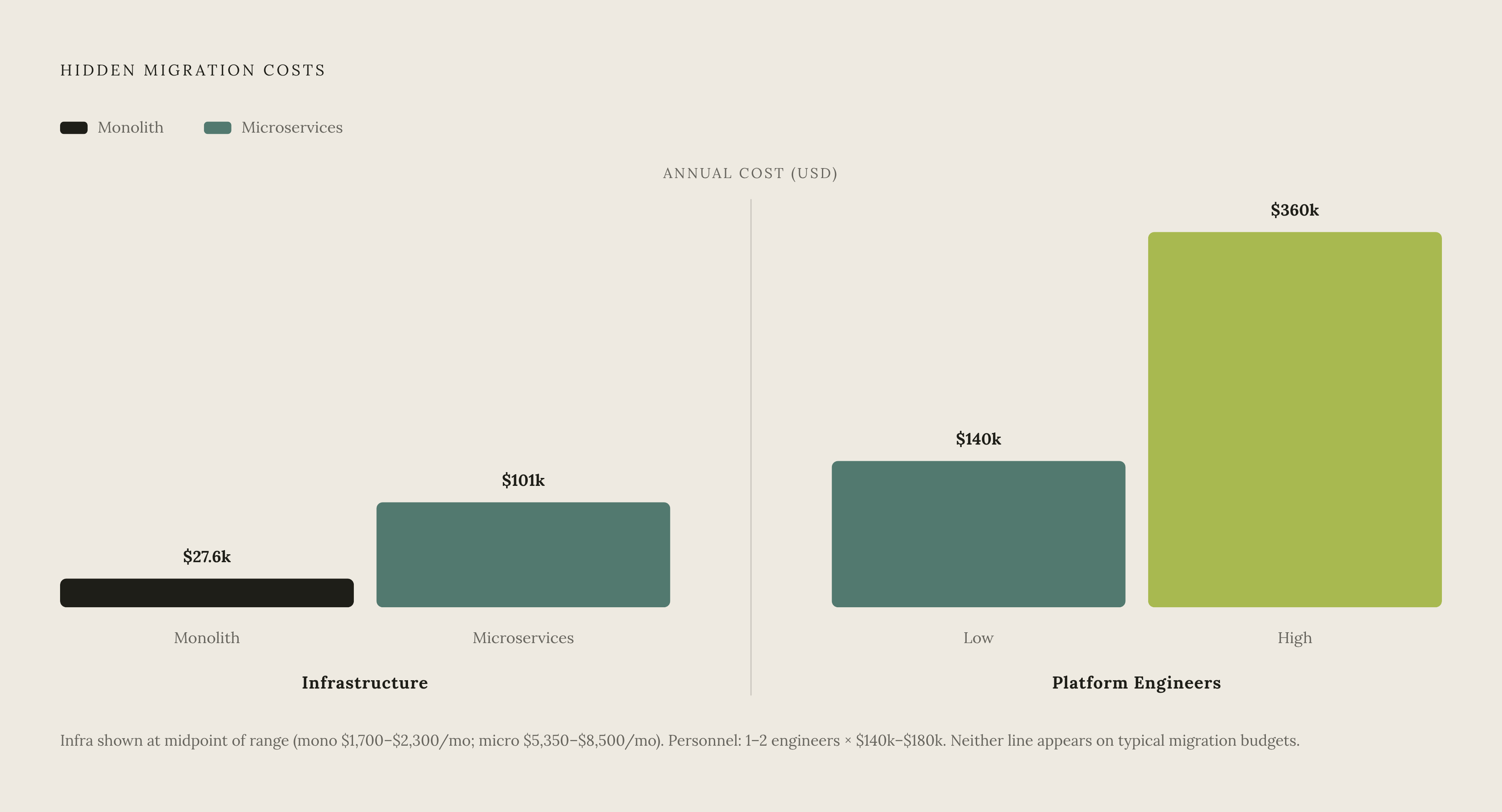
Running a monolith typically costs around $50,000 a year in infrastructure. An SRE team supporting an equivalent microservices setup runs $200,000 to $500,000 a year, and that's before counting the cloud bill itself, which often rises 2x to 3x after the split. Teams running identical features and identical traffic have reported jumps from $500 a month to $3,000 a month, just from decomposing the same functionality into separate services.
Research from Cast.ai puts the infrastructure premium at roughly 30% to 40% higher for microservices versus an equivalent monolithic app, driven by per-service overprovisioning, extra networking layers, and middleware that gets duplicated across every service instead of running once. For a mid-sized application, a modular monolith runs roughly $1,100 to $2,300 a month. A 10-to-15-service microservices setup for the same workload runs $4,200 to $8,500, and that's before adding the platform engineers needed to keep it running.
The personnel costs that dwarf the infrastructure line items
Infrastructure is the cost people notice. Personnel is the cost that actually moves the budget.
A microservices architecture typically needs 2 to 4 dedicated platform engineers, on top of the operational load that gets distributed across every product team touching the system. Platform engineers command average salaries of $140,000 to $180,000 a year. Do the math on just the incremental headcount, the 1 to 2 extra engineers most teams add specifically to support the new architecture, and that's $140,000 to $360,000 a year in salary alone. Compare that to the infrastructure delta from the section above. Personnel wins, and it's not close.
DORA metrics research has found that 90% of microservices teams still batch deploy their services together. That defeats the entire premise. Independent deployment is the primary benefit microservices is supposed to deliver, and nine out of ten teams running the architecture aren't actually using it that way. So what exactly is being paid for?
The hidden costs that don't appear in any budget line: debugging, observability, and coordination
None of the costs above appear as a line item until they've already been spent.
Debugging is the clearest example. Teams report spending roughly 35% more time debugging issues in microservices architectures compared to modular monoliths, largely because a request that touches six services is much harder to reproduce on a laptop than a bug that lives inside one process. Test reliability tells a similar story. Commentary drawing on Google's testing research and State of DevOps data puts end-to-end test reliability at 70% to 90% for monoliths, versus 40% to 60% for microservices, and that gap widens with every service added to the system.
Observability isn't optional once services are talking to each other over the network instead of calling each other's functions directly. Correlating logs, metrics, and traces across dozens of network hops takes serious tooling and, more importantly, someone whose job is managing that tooling. That's a staffing cost that scales with the number of services running, not a software licensing cost. It's a staffing cost that scales with the number of services running.
Coordination is the least visible cost and maybe the most corrosive. Every service boundary is also an organizational boundary: a "network handshake" that used to be a function call is now a contract between two teams. Without clear APIs and contract testing in place from day one, that turns into a proliferation of alignment meetings and cross-team dependency tracking, quietly eating the exact velocity gain the migration was meant to produce.
The new technical debt the migration itself generates on top of the debt it was meant to resolve
Migrations get framed as debt-reduction projects. The pattern that emerges from real migration post-mortems tells a less flattering story: developers, faced with new complexity right after a transition, tend to reach for whatever solution ships fastest, and those quick fixes compound, dragging software quality down over time rather than up.
A pattern that's almost predictable follows: organizations prioritize new features over refactoring during and immediately after a migration, because the pressure to prove the new architecture was worth it is highest right when the system is least stable. Every deferred refactor is new debt, stacked directly on top of the debt the migration was supposed to erase.
The dependencies don't disappear either. They just move. A payment service that calls three external providers, loads a library nobody remembers needing, and occasionally hits a process that was supposed to be retired years ago doesn't get cleaner when it's extracted into its own service. It gets re-encoded into an inter-service contract, where the same mess is now harder to see and even harder to change, because changing it means coordinating with whoever owns the service on the other end of that contract.
The industry has started saying this out loud instead of quietly walking it back. Kelsey Hightower, formerly a Distinguished Engineer at Google, put it bluntly: monoliths are the future, because the problem people are trying to solve with microservices doesn't line up with the reality most teams actually face. Sam Newman, who wrote the book on the subject (literally, "Building Microservices" for O'Reilly), has said most teams shouldn't start there. The underlying instinct has a name in the industry: wanting the architecture because of who else uses it, not because of what a given system actually needs.
The MVP-to-production trap: when an architecture built for speed becomes a liability at scale
Monoliths are genuinely the right call for an early product. A small team still figuring out what the product even is benefits from speed to market more than from anything a distributed system can offer, and a monolith is faster to build, faster to change, and far easier to reason about with five engineers than fifty.
The trap springs the moment that MVP actually works. A tightly coupled monolith that was exactly right for validating an idea becomes a liability the second the company needs to scale it, and refactoring that architecture at Series A can cost 4 to 6 times what building it modularly from the start would have. Split-service MVPs built in 2022 spent roughly 38% of total development hours on infrastructure plumbing instead of product work. Modular-monolith MVPs built in 2025 averaged just 12%.
Below 10 to 15 engineers, full microservices is, more often than not, a financial mistake. Plenty of startups heading into 2026 are landing on the same conclusion: a well-structured modular monolith delivers most of the benefit without the exponential operational tax that comes with running a distributed system before there's a team large enough to justify one.
An honest migration decision: the conditions that justify the full cost
So when does the full migration actually earn its cost? Team size is the clearest signal. Microservices tend to start paying for themselves once an organization passes roughly 30 engineers who need the architecture to distribute complexity across teams so everyone can keep shipping without stepping on each other. Below that threshold, the coordination overhead described earlier usually costs more than it saves. Not sometimes. Usually.
Beyond headcount, a handful of legitimate triggers exist: a specific workload, payments processing being the classic case, that needs to scale independently from the rest of the system, a regulatory requirement that demands isolation, or multiple genuinely independent teams that can't share a deployment cycle without blocking each other every release.
For everyone else, the modular monolith is the honest middle ground: one deployable unit, module boundaries enforced strictly, a schema per module. That gets most of the organizational clarity teams were chasing when they reached for microservices, without the operational tax of running a distributed system nobody yet needs. Individual services get extracted later, one at a time, when traffic data, scaling numbers, or real team friction demand it. Not because a conference talk made it look inevitable.
And for the teams that do clear the threshold, the Strangler Fig Pattern still holds up as the right way to get there: gradual extraction over 18 to 36 months that bets on getting the new architecture right incrementally rather than all at once.