Technology Capacity Building for Nonprofits on Restricted Budgets
Technology capacity building for nonprofits on restricted budgets is about treating technology as mission infrastructure so that money and staff time build lasting capacity. That shift starts with fewer disconnected systems, extends to the care of custom software, and shapes which technical support and funding are worth pursuing.
Why nonprofits are being forced to reckon with technology infrastructure right now
Funding has become more competitive and restricted, while government support has been frozen, delayed, or cut for a significant share of organizations. Demand has surged across housing, food insecurity, mental health, and economic support. The squeeze runs in both directions at once. Teams must serve more people while having less freedom to decide how their money is spent.
Yet expectations for professional operations have not shrunk. Nonprofits are still expected to measure impact, maintain secure systems, and work efficiently, even when the resources behind those tasks are thinning. NetSuite identifies technology shortcomings as one of four core nonprofit challenges in 2026, together with funding, leadership, and collaboration. Inadequate systems are an operational barrier. As boards and executive directors scrutinize every expense, deferred decisions about overlapping software and unreliable tools become harder to avoid.
What it actually means to treat technology as mission infrastructure rather than overhead
The overhead frame asks how little technology can cost. The infrastructure frame asks what reliable systems make possible. A modest monthly fee can be worthwhile when it saves significant staff time each week, leaving more capacity for programs without adding headcount.
Does the system reduce manual steps, reduce logins, or shorten the time needed to produce a funder report? If so, it supports mission delivery. If it adds maintenance without releasing capacity, its value needs scrutiny.
Why the tool stack is usually the first place the overhead frame shows up — and what to do about it
Many nonprofits run six or seven disconnected systems accumulated through separate decisions. A pandemic tool remains in use in 2026, while a donor database outlasts the staff member who chose it. Each may have met a real need at the time. Together, however, they create work that no subscription invoice shows. A fundraising team stitching donor history together from a CRM, a spreadsheet, and a contact sheet is spending time reconciling information.
For a small team, consolidation is the practical starting point. Check every recurring software fee, then work out which tasks Google Workspace or Microsoft 365 could handle for free or with tools the organization already pays for. The aim is fewer tools that do more. Zeffy offers a fully free fundraising platform with no platform fee, transaction fee, or credit card fee, making fundraising charges another place to look for recoverable budget. Those savings can support gaps that cannot be filled for free.
Before consolidating, name the person who will own the resulting system on Monday morning. Ownership is part of the cost calculation. A setup that depends on a maintainer the organization does not have may reduce subscription spending while increasing the burden on everyone else.
The specific problem with Airtable and what nonprofits replacing it are actually choosing
Bending Spoons announced its acquisition of Airtable in August 2026 and completed it on September 4, 2026. That change leaves nonprofits less sure about the platform’s future when per-seat pricing already fits poorly with how they need to work. It makes evaluation reasonable. What is the organization actually using Airtable to do?
For a close like-for-like swap, Baserow can be self-hosted for free and supports GDPR, HIPAA, and SOC 2 compliance. It is lighter on automation and AI than commercial platforms. Self-hosting also assigns backups, updates, and monitoring to the organization.
NocoDB suits teams that already have a MySQL or PostgreSQL database and want a no-code interface without migrating the data. It offers grid, Kanban, form, gallery, calendar, and other views, with a free open-source tier available. SQL Server support is an Enterprise-only add-on. The distinction affects which version fits the existing database.
Grist combines spreadsheet formulas, including Python, with database structure, making it relevant to deep customization and large-data needs. Its REST API and webhook integrations have no built-in caps on the number of actions, but cloud plans rate-limit API calls. Native in-app Automations are cloud-only.
Notion suits organizations that want documentation and databases in one workspace, and nonprofit discounts are available. Google Sheets and Microsoft Lists are simpler choices for single-table workflows that do not need relational structure. Workspace is free for qualifying nonprofits, while Lists is included in Microsoft 365 at no additional cost. Noloco offers nonprofit pricing and a no-code app builder for tailored CRMs, client portals, and member portals without a developer. The choice turns on the workflow and its upkeep.
How technical debt accumulates in nonprofit-built tools and why patching it makes it worse
For nonprofits that have commissioned case management systems, volunteer portals, or donor databases, the problem can run deeper than disconnected subscriptions. A minimum viable product, or MVP, may become the permanent system before anyone recognizes the cost of its shortcuts. This is a diagnosis. Decisions about architecture, testing, and infrastructure can constrain future work even when the tool still appears to function.
Two categories help distinguish tolerable compromises from structural trouble. Strategic debt includes hardcoded configurations or manual processes accepted during initial validation. Accidental debt includes tangled business logic, absent tests, and undocumented architecture. The first can be a reasonable early trade-off. The second makes new features harder to add, creates reliability problems, and obstructs outside developers trying to help.
The danger grows when temporary shortcuts become the usual way to build software. Staff absorb the consequences through workarounds and manual reconciliation, so the cost rarely appears against the software that caused it. More patches can deepen the underlying problem. They add surface area to a fragile system without removing the accidental debt, leaving the organization to pay for it in staff time and instability.
What to do when the custom tool needs more than a patch but the budget isn't there for a full rebuild
A constrained nonprofit in that position needs triage before a rebuild proposal. The first task is to separate accidental debt that blocks operations from strategic debt that is merely suboptimal. Reliability failures, reconciliation that consumes staff hours, and an inability to bring in developers justify urgent attention. Not every compromise requires emergency spending.
If the core architecture limits integrations, scaling, and reporting, a targeted rebuild of that layer can cost less over two years than continued workarounds and instability. The intervention need not encompass the whole tool. For organizations using AI-generated or no-code MVPs, the central gap may be production reliability. Reaching launch and staying live are different standards once people depend on the service.
Seek a technical partner who can distinguish what needs rebuilding from what can be stabilized, and who stays involved. Support arrangements deserve scrutiny before the engagement begins. Will the partner be there when something breaks at 2am, or will the organization be left with an invoice and a Slack thread? A constrained budget makes that question more important.
Pro bono and low-cost technical support programs that are open to nonprofits right now
Structured pro bono programs offer expertise as well as donated software, but their engagement models differ. Taproot Foundation has mobilized skilled professionals since 2001, serving thousands of organizations through over a million hours of work. Its projects include work on marketing, strategy, technology, and AI implementation. Taproot also developed a Product Donations + Pro Bono Service Playbook to address the gap between donated products and successful implementation. It is relevant where access to software has not supplied the knowledge needed to use it.
Develop for Good pairs college student teams with nonprofits for design and development projects. Its volunteers have worked on 370 nonprofit software projects, including app design and website builds. The Nonprofit Open Source Partnership, organized by Bloomberg, Develop for Good, CodeDay, and Fast Forward, offers each selected nonprofit eight vetted college student volunteer developers for 16 weeks. Weekly check-ins, technical guidance, and project management make it an option for substantial, well-scoped engineering work.
SoftServe OpenTech runs an annual Open Call. Its 2026 call received a record number of applications from nonprofits, charitable foundations, and social enterprises across Ukraine, Poland, Mexico, and Colombia. Team4Tech runs structured micro-projects that bring corporate volunteers and nonprofits together for pro bono consulting. That model works better for advice on a clearly defined need than for full engineering builds. Availability depends on program selection cycles, so an annual call should not be read as a continuously open application window.
The practical choice begins with the project’s scope. Taproot fits advisory needs, Develop for Good fits defined software projects, and the partnership offers a more intensive engineering engagement. Every model still needs internal participation. A clear brief, a point of contact, and time to review work are prerequisites for volunteer effort to become something the organization can maintain.
Tech grants that are open to applications now and what they actually cover
The following programs were open as of September 2026. Their benefits cover different needs, so they can be combined. These benefits come in the form of software and advertising. That distinction helps teams match them to actual gaps in the budget.
Google Ad Grants is open to nonprofits that qualify and want to run text ads on Google Search for keywords tied to their mission or services. It supports awareness, volunteer recruitment, and service promotion. To qualify, nonprofits must have valid charitable status, agree to Google’s policies, including its non-discrimination policy, and have a working website with high-quality content.
Google Workspace for Nonprofits is open through the same Google for Nonprofits account used for Ad Grants. Valid charitable status and completion of Google’s verification process are required. Qualifying organizations receive the full Workspace suite at no cost, including Sheets, Docs, Drive, and Meet. Claiming one benefit does not replace the other.
Canva for Nonprofits is open and provides Canva Pro at no cost for graphics, presentations, social posts, and print collateral. Applicants must be independent of government and not operate for commercial profit, with verification handled by a third-party service. Government agencies, political organizations, educational institutions, grant-making foundations, and private foundations of any type are ineligible. That rule covers family, corporate, and institutional foundations, however they are run.
For teams that qualify, Workspace and Canva can take the place of productivity and design tools they pay to use. Grants for broader digital transformation may take applications once a year. Those windows require planning rather than assuming funding will be available when a project becomes urgent.
How to sequence these moves when capacity is limited and everything feels urgent
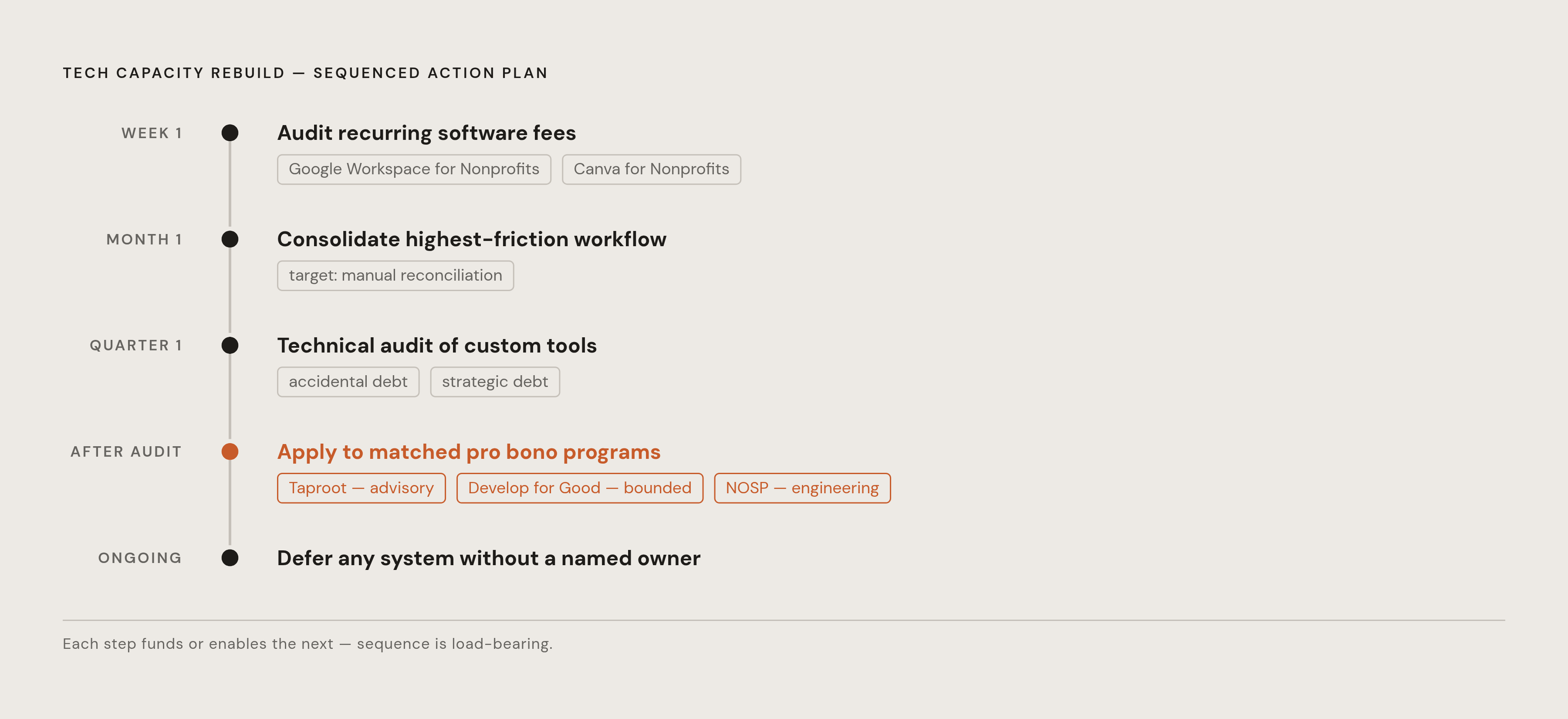
The first move should release resources. In week one, audit recurring software fees and apply for Workspace and Canva if the organization qualifies and has not already done so. Recovered fees provide a seed budget.
In month one, identify the workflow responsible for the most manual reconciliation or staff workarounds. Make that the consolidation target, using time returned to mission work as the test. During quarter one, organizations with unreliable custom tools should commission an honest technical audit. Ask for triage. The organization should name the accidental debt before it commits money to removing it.
Pro bono applications can then follow a defined need. Match advisory work, bounded projects, and substantial builds to the relevant programs, applying before the need becomes urgent because selection takes place in cycles. If no one can own the resulting system, defer the commitment. The goal is not a sweeping transformation, but a leaner stack, recovered budget, and a clearer account of what needs repair. Each completed move should create the time, money, or knowledge that makes the next one possible.