Technical Debt Audit Process for an Inherited Codebase
A technical debt audit is a structured process for making invisible debt visible, pricing what it costs, and ranking it so a team can decide what to fix, what to leave, and what to rebuild. Done well, it produces a prioritized map that separates what's safe to build on from what has to be repaired before any real growth happens, and that map is also the first thing a software partner should produce before signing on to work with you.
Why inheriting a codebase is not the same as inheriting a working product
Inheriting a codebase feels, at first glance, like inheriting a finished thing. The app runs. Then a release that should have taken two days takes two weeks, a routine deploy breaks something nobody touched, and the question starts to form: what is actually wrong here, and how much of it is there?
That gap between "this runs" and "this is sound" is where technical debt lives, and it's hard to see precisely because nobody tracked it or priced it along the way. When they leave, that context goes with them, and what's left behind is a set of decisions with no record of why they were made.
A team taking over a codebase is taking on a portfolio of obligations it doesn't yet know it has, rather than reviewing a finished product: fragile modules, undocumented workarounds, dependencies nobody has updated in two years. It matters the moment real users show up, because the debt that was acceptable at MVP speed turns into a reliability problem, and reliability problems slow growth directly. This tension, between what got a product to launch and what keeps it running once people depend on it, is usually the moment teams realize the product needs rebuilding on solid foundations. Studios like Quwa Labs specialize in making that refactor-versus-rebuild call on inherited codebases, particularly ones shipped fast with AI tools or freelancer work, and an audit is how that decision gets made visible.
The categories of debt that matter in an inherited codebase
Not every rough edge in a codebase deserves attention. The audit's first job, conceptually, is sorting debt that changes delivery, reliability, or security from debt that's simply unpleasant to look at.
A useful way to see the stakes: fragile core modules slow down every feature built near them. Poor boundaries between modules raise the cost of onboarding anyone new. Dependency drift, meanwhile, creates both security exposure and upgrade risk that compounds the longer it sits.
Four categories cover most of what appears in an inherited codebase. Stalled migrations cover the half-finished moves, a database switch abandoned halfway, a framework upgrade started and dropped, that leave two systems running where one was meant to.
Martin Fowler's Technical Debt Quadrant still holds up as a sorting tool here. Debt splits along two axes: deliberate versus inadvertent, and prudent versus reckless. Fixing it would cost more than leaving it alone.
One category deserves particular attention because it's newer and growing fast: AI-generated code. When different AI coding sessions, each working with its own limited context window, make locally reasonable choices without awareness of what came before, the result is architectural drift. The codebase ends up with three or four different patterns solving the same problem, none of them wrong in isolation, all of them inconsistent together. This kind of structural inconsistency needs a different detection approach than hand-written legacy debt does, because the cause isn't a developer who left but a tool that never had the full picture, and it's a growing presence in the inherited codebases that early-stage teams bring into a rebuild conversation.
Securing assets before the first line of code is read
Before any code gets reviewed, ownership of the accounts and infrastructure has to be settled. Unsecured access is itself a critical vulnerability, not a side issue to clean up later.
The first move is a full inventory of every platform the product touches: cloud accounts, the domain registrar, DNS, app store accounts, payment providers, email providers, and the CI/CD system. Once that inventory exists, access needs to move under accounts the team actually controls, and every credential touching those systems needs to be rotated. A developer who's gone but still holds live keys to production is a risk no code scanner will ever catch, because it isn't in the code at all.
This inventory step gets skipped more often than it should, and skipping it means auditing a codebase the team doesn't yet fully control. Whatever turns up during this step, gaps in access, integrations nobody remembers setting up, should get written down as the audit's first set of discoveries, because it is part of the real work, not administrative housekeeping separate from it.
Once ownership is settled, the audit can actually see what it's looking at.
Phase 1: Orientation before judgment, reading the codebase before forming opinions
The most common way an audit goes wrong is forming opinions before building a real mental model of the system. Findings without context are guesses dressed up as conclusions.
Orientation means reading the manifest, mapping out the directory structure, running a git log analysis to see which files change the most, and writing down a mental model of how the architecture actually works, all before a single finding gets recorded. This step is the real work, at least at this stage, not one to rush through on the way to it.
Git churn analysis is particularly useful here: it shows which files get modified most often. Where high churn overlaps with large, sprawling files, that intersection is usually where debt hides, because those are the places under the most pressure and the least able to bear it. A sound audit process starts by identifying those high-change areas and reviewing the history of bugs and painful releases tied to them, not by running a scanner and seeing what lights up.
The mental model written at the end of this phase is a deliverable in its own right, separate from anything that comes later. Some of the most useful findings come from the things a checklist was never built to catch.
Phase 2: Sweeping across the nine dimensions with tools and human judgment
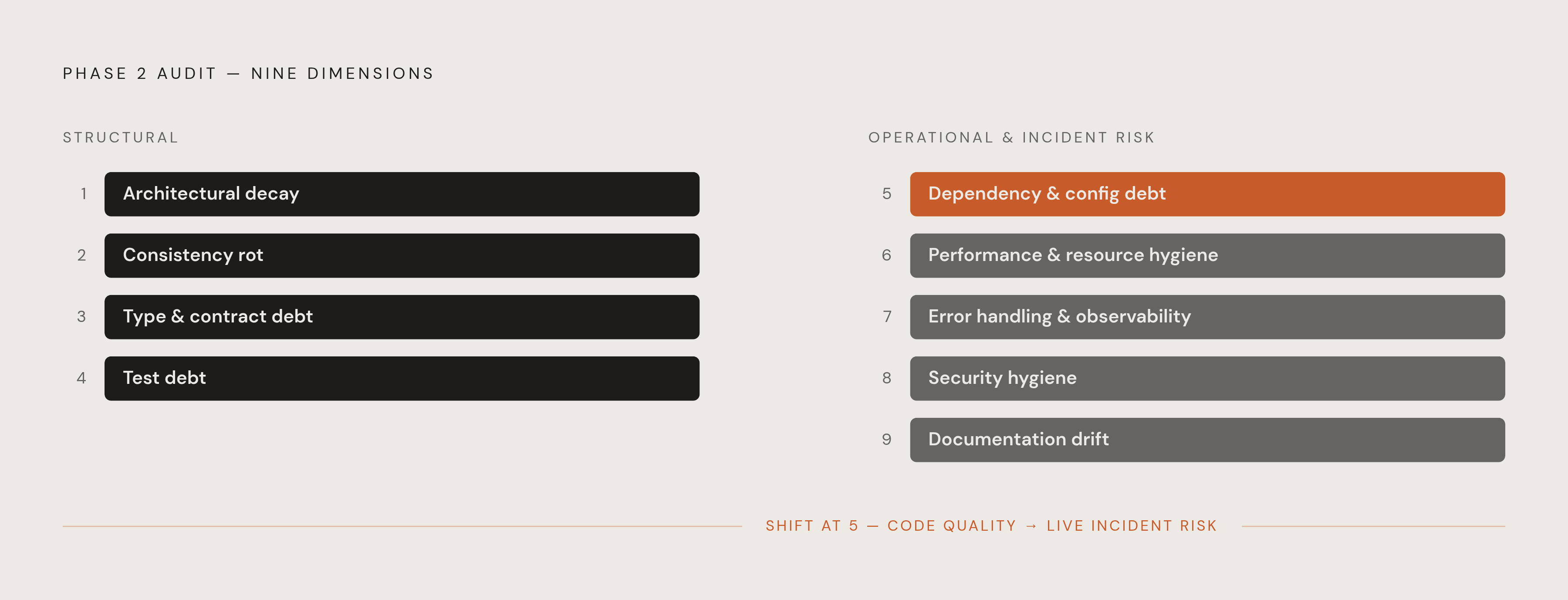
Automated tools can catch a lot. A person has to close the loop on anything architectural or tied to business logic, because no scanner understands what the product is actually supposed to do.
Nine dimensions cover the meaningful ground: architectural decay, consistency rot, type and contract debt, test debt, dependency and configuration debt, performance and resource hygiene, error handling and observability, security hygiene, and documentation drift. The later ones touch operations and security, the places where a gap turns into an incident.
Each language ecosystem has its own native tools for this pass. On a large repository, this work should run in parallel across modules. A single pass working through everything sequentially will run out of steam before it ever reaches the point of producing a usable report.
Every finding needs a score across six factors: how often the affected area changes, its history of defects, the impact on customers, any security exposure, the cost of onboarding someone new to that part of the code, and the cost of actually fixing it. And every concrete finding needs a file and line citation. A finding without one can't be checked against reality, and findings that can't be checked tend never to get fixed.
A section documenting calls the auditor considered and chose not to make keeps the audit honest, because it forces a record of things that look bad on the surface but turn out to be fine once you understand the context. If that section comes back empty, the audit probably didn't look hard enough. This single habit, forcing someone to show their work on what they decided to leave alone, tends to separate a real audit from a checklist run on autopilot.
AI-generated code needs its own specific check in this phase. The relevant check is whether the code was reviewed, tested, and integrated in a way that's consistent with the rest of the system. One academic study of live, deployed applications found that 65.77% of the vulnerabilities uncovered were rated Critical or High severity, and the architectural drift described earlier appeared exactly as expected: multiple patterns solving the same concern, scattered across a single codebase with no single author accountable for the inconsistency.
Phase 3: Producing a prioritized map, not a shame document
An audit that ends with a list of problems hasn't finished its job. The deliverable has to turn debt into something a team can decide about, not something to feel bad about.
A finished audit sorts everything into three buckets: what needs fixing before it breaks something, what can be left alone because it's stable and rarely touched, and what should be rewritten because keeping it costs more than replacing it would. Getting that ordering right is what separates a rewrite that pays for itself from one that stalls out halfway through.
Each finding gets matched to one of a few response modes. And sometimes old code has to keep running in production while new functionality gets built around it, which calls for wrapping it.
The finished report should include an executive summary with finding counts by severity, a findings table listing each item's ID, category, file and line, severity, effort estimate, description, and recommendation, a top-five list of priorities, a set of quick wins, the "looks bad but fine" section, and a list of open questions still worth investigating.
The pattern that actually gets debt funded is attaching a business case to each priority. Most teams, once they see the map, don't actually need a full rewrite. They need a smaller, sequenced plan that lowers risk while the product keeps moving, because a sweeping refactor with no clear priority order often introduces more risk than it removes.
Sizing the audit effort so it does not become the project
The audit's scope should be predictable based on the size of the codebase, and treating it as open-ended helps no one. An audit that never ends is a second project competing with the one the team actually set out to do.
AI-assisted analysis has changed the economics of this work in a real way. Mapping out debt used to take weeks of manual digging through old code, commit by commit. That cost is a large part of what made legacy code audits expensive and slow in the first place, and it's shrunk significantly with tools that can move through a repository fast.
Early-stage teams sometimes over-engineer for users they don't have yet, and the time spent auditing is real time, while the debt itself is still theoretical until it actually causes a problem. Scoping the audit to the size of the codebase from the start, with a clear timeline attached, bounds the work. That bounds the work on both sides. It surfaces real problems without eating into the roadmap the team actually needs to execute.
A stale inventory is a real trap: a working group puts together a debt register, presents it with some fanfare, and six weeks later the register no longer matches reality, because the codebase kept moving while it was being catalogued. The fix is a persistent, citable artifact committed directly into the repository and updated every time the audit runs again, not a better one-time document.
How to maintain the debt map after the audit closes
A single audit produces a single moment of clarity. Keeping that map current is what turns the audit into something that compounds in value instead of decaying the moment the report gets filed away.
A few failure modes tend to eat up that value once the initial work is done. And there's the ownership vacuum, where debt that cuts across teams ends up belonging to no one in particular, sitting in the seams where no single team has both the authority and the incentive to fix it.
The fix for the stale inventory problem is running the audit in repeat mode against the same persistent artifact. Resolved findings get marked RESOLVED. Ones that have changed get updated. New findings get tagged NEW. Over time, the audit shifts from a one-time snapshot into a living document that actually reflects the state of the codebase.
On the allocation side, it helps to protect a fixed portion of each sprint for debt reduction and treat that time as non-negotiable, the same way feature work gets protected time. A living debt map, maintained this way, lets a technical partner stay ahead of production problems by catching them before they happen.
What to do when you cannot run the audit yourself
For founders and small teams, the bottleneck is usually having the senior engineering capacity to actually run an audit and then own whatever remediation comes out of it, not understanding what the audit should cover.
An audit run by the same team that wrote the code carries a built-in blind spot. When a team is transitioning away from a third-party development shop, an outside audit should objectively assess the quality of the codebase, identify the debt sitting inside it, confirm that documentation and knowledge transfer have actually happened, check how well the code aligns with internal standards, and flag any licensing or compliance issues tied to third-party components.
A founder who built an MVP with AI tools or a freelancer, and now has real users depending on it, is in exactly the position this audit is built for. The same study cited earlier found that 91% of analyzed applications built largely through AI code generation contained at least one vulnerability, which makes that assessment step before scaling further, not optional.
The right external partner doesn't hand over a PDF and vanish. A partner worth the engagement rebuilds on what the audit found and stays on as a long-term technical partner, freeing the founder to spend time on go-to-market. That's what separates an audit as a one-time report from an audit as the start of an actual working relationship.