Reliability Standards That Change at First Enterprise Customer
A first enterprise customer does not raise the bar on a product. The founder in this moment usually still has the old frame in their head, the one that asks "does it work?" That question stops being the one procurement is asking. A security questionnaire arrives, or a vendor risk form, or a quiet request for a SOC 2 report, and the honest answer to half the questions doesn't exist yet. This piece walks through exactly which standards change, why they all change together instead of one at a time, and what separates the founders who close that deal from the ones who lose it in the first 90 days.
What MVPs survive and what they don't
An MVP exists to answer one question: is this idea worth building further? Everything about a good MVP points at that question. It's built to learn fast, not to last long, and it was never meant to carry high traffic, complicated workflows, or years of maintenance.
Founders tend to blur three distinct stages together. An MVP is the first market-ready version, built to deliver real value to real users, where the open question is whether the market wants it, not whether the code can technically run.
That last distinction matters because of what it implies about risk. At the MVP stage, the risk is a business risk: will anyone pay for this, will anyone use it twice. It is not a technical risk. None of that is sloppy work. It's the correct decision for a product trying to prove itself in weeks, not years.
The trap occurs when teams treat "fast and cheap" as a permanent strategy rather than a phase-appropriate one. A rebuild gets forced, and it gets forced at the worst possible time: when traction is finally real, when the business can least afford downtime, when a sales team is trying to close the exact customers the product can't yet support.
None of this makes technical debt a mistake. Debt of this kind is effectively free, right up until a triggering event calls the loan: a funding round, a compliance audit, a security review initiated by an enterprise client. That triggering event has usually been building quietly for a year or more before it lands on someone's desk.
The five standards enterprise procurement replaces
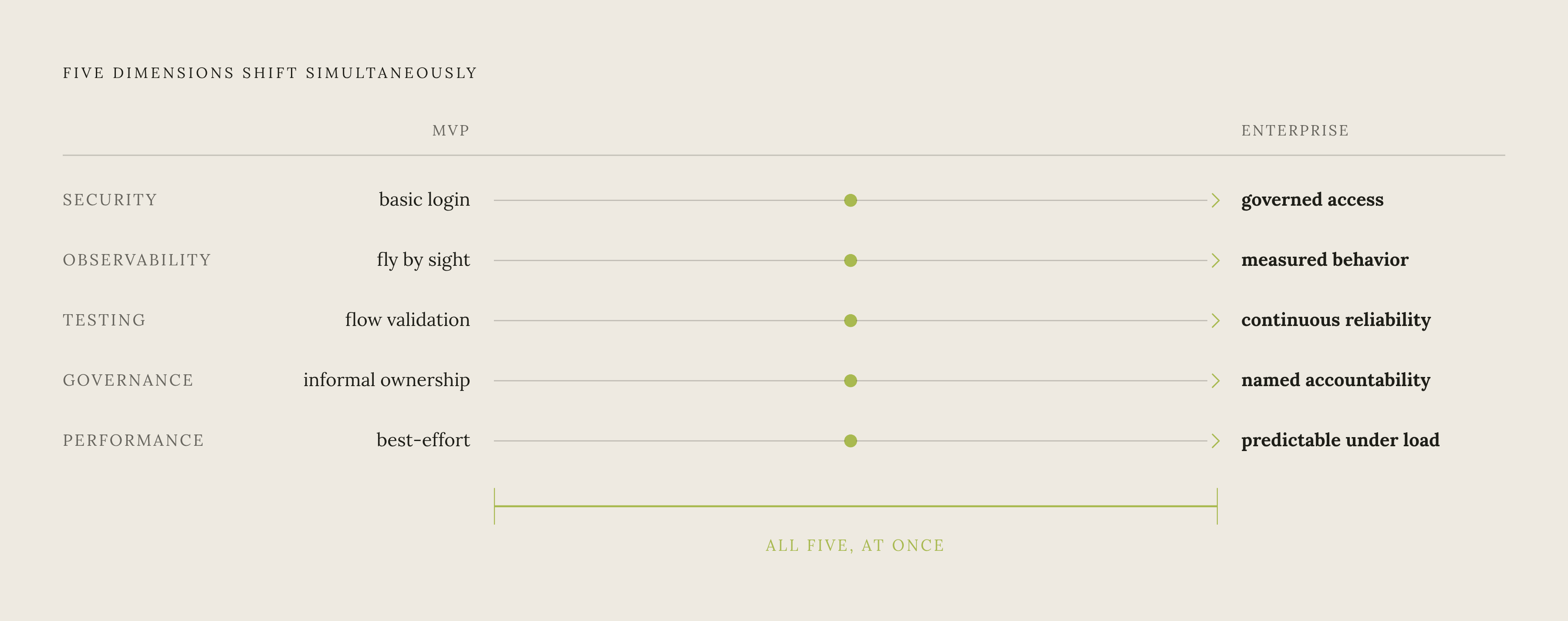
Landing an enterprise customer means five architectural dimensions get replaced at once, because enterprise procurement evaluates all five simultaneously, not in sequence.
Security moves from basic login protection to governed access. Security bolted on after launch always costs more and carries more risk than security designed in from the start. An MVP's auth model can't be stretched to cover this; it has to be replaced.
Observability moves from "fly by sight" to measured behavior. Without that instrumentation, a founder can't prove the system meets an SLA, can't catch an incident before it escalates, and can't answer the question a procurement team will ask directly: how do you know the system is healthy right now?
Testing methodology moves from flow validation to continuous reliability. MVP testing usually checks that the core user flow works. That means automated unit and integration tests, regression testing on every release, and load and performance testing as a standing practice, not a one-time check. This is a different testing discipline built from the ground up, not an expanded version of the old one.
Governance and change control move from informal ownership to named accountability. Deploying on a Friday afternoon is a fine way to run a two-person team. The AWS Well-Architected Framework captures why this matters by naming six pillars that recur as sources of real production risk: operational excellence, security, reliability, performance efficiency, cost optimization, and sustainability.
Performance guarantees move from best-effort to predictable response under load. Users will forgive a slow MVP. They do not forgive a slow production system, especially not one they're paying an enterprise contract for. A broken flow in production doesn't just annoy a user, it can cost trust, retention, and revenue, and sometimes it costs a customer for good.
Why SOC 2 makes the phase change undeniable
SOC 2 is where all five of those abstract shifts turn into one very specific deadline.
The practical trap is timing. SOC 2 comes in two stages. But a founder who only starts the process once a deal requires it cannot produce a Type II report fast enough to save that deal. The groundwork has to start before the deal is even on the table.
Patterns from real engagements show how tight the window can be. One company, Weave, reached SOC 2 Type I in under 30 days from kickoff and used it to close deals that had been stuck waiting on exactly that attestation. Harvey AI offers a different version of the same lesson, from a regulated market where trust can't be assumed. In a regulated market, that kind of deliberate, documented reliability can't be deferred to later, because a generic, unverified alternative simply can't earn the same trust.
How technical debt compounds when the enterprise trigger arrives
Technical debt acts like a tax on engineering time, and the rate on that tax rises sharply when enterprise requirements appear alongside growth pressure. On a small team, that shift alone can eat a large share of total output, leaving far less capacity for the new work the enterprise deal actually demands.
The trigger is what makes the hidden cost visible. The debt has usually been accumulating for a year or more without anyone treating it as urgent.
A second kind of trigger comes from a pivot. Old design choices that made sense for a consumer product become obsolete in a single conversation.
This is consistent with what a lot of founders report as their biggest obstacle to growth: technical debt, specifically at the exact moment they're trying to scale. Procurement due diligence and real system stress tend to hit at the same time, right when a founder most needs engineering capacity free to handle both.
A product built for speed, by a founder, a freelancer, or AI tools, that later meets real users at scale usually finds its old shortcuts have become structural liabilities. Product studios like Quwa Labs work specifically in that gap, taking products that proved an idea and rebuilding them on foundations meant to hold up under production traffic and compliance review. Teams that treat their MVP as a real foundation from the start, rather than a disposable prototype, tend to avoid the forced, all-at-once rebuild that happens after traction is real and the business can't afford to pause.
Where no-code and AI-built MVPs accelerate the reckoning
No-code tools and AI-generated codebases get products to market faster than almost anything else available, and that speed has a cost on the back end: the runway before the platform itself becomes the limiting factor gets shorter too. The reliability ceiling in these cases is built into the tool itself.
Airtable is the clearest example. It's genuinely good at what it's designed for: organizing work the way a spreadsheet does, with linked records and easy sharing across a team. But teams run into hard walls when they try to scale the amount of data it holds, control who can access what, or build external-facing portals for customers or partners, and those are exactly the capabilities enterprise buyers expect to see on day one of a deal.
Airtable's acquisition by Bending Spoons in September 2026 added a second kind of pressure on top of the feature limits. A question that used to be purely technical, can this tool do what we need, has turned into a business continuity question, can we count on this tool still being here in its current form.
The platform a team picks effectively sets the reliability floor before anyone writes a line of application code, because the decision about where data lives and who controls the schema gets made the moment the platform is chosen. A few categories matter here. NocoDB takes a different approach: it sits directly on top of an existing production database, PostgreSQL, MySQL, and others including SQL Server and Oracle, turning raw tables into an interactive interface without moving the data anywhere. That's a "bring your own database" model, and it keeps a team's IT or engineering group in control of the underlying schema the whole time. On the SaaS side, Quickbase fits teams that need mature low-code infrastructure with real enterprise governance built in, priced around $35 per user per month annually plus a platform minimum fee. And for teams whose real need is a governed internal application rather than database management itself, tools like Jet Admin and Retool treat the underlying data as an input and produce an application layered with permissions and workflows on top.
Across all of these, the deciding factor for an enterprise buyer usually isn't which tool has more features. Airtable keeps its audit logs largely locked to its highest tier, Enterprise Scale, with some permissioning spread into the Business tier below it, which turns the question of which plan a team is on into a structural question, not just a budget line.
Migrating off Airtable or a similar tool is the precondition for even being eligible for the enterprise deal in question. The architecture a team picks has to match the compliance and data sovereignty terms the deal requires. Quwa Labs works with founders in exactly this spot: teams that shipped fast on no-code or AI-generated foundations and now need that system rebuilt on production-grade architecture before an enterprise relationship can move forward, with the studio owning the migration itself so the founder's attention stays on closing the deal.
How nonprofits encounter the same phase change
Nonprofits hit this same wall, just through a different entrance. A grantmaker or a government contractor functions, in practice, like an enterprise client: it arrives with its own requirements for data collection, retention, access control, and compliance, regardless of whether the organization's systems are ready for them.
Social work and human services agencies operating under government contracts can face HIPAA obligations when they qualify as covered entities or business associates, along with case confidentiality rules and formal client consent protocols. None of that arrives gradually. It arrives the moment the contract is signed.
Many nonprofits build up a kind of invisible infrastructure debt over years, running on systems stitched together from donated software, old grant-funded tools, and licenses nobody remembers renewing. The strain is getting worse, too: a growing share of organizations report trouble using their own data to make decisions, and data management and CRM problems are now being flagged at more than double the rate they were the year before. That pattern fits systems that were fine for internal use but were never built for the reporting and audit demands funders now attach to their money.
The Airtable acquisition lands especially hard here. Quwa Labs works with organizations facing exactly this mix of constraints, tight budgets, mission-first decision-making, staff covering five roles at once, and treats the nonprofit case as its own distinct problem rather than a smaller version of the startup one, because the organizational context around the technical debt is just as real as the debt itself.
What Founders Who Close and Keep Enterprise Deals Do Differently
Founders who make it through the first 90 days with an enterprise customer tend to treat reliability as something that drives growth, not something nice to have once growth shows up. That means dealing with the five structural replacements before the contract is signed.
Timing drives almost everything here. SOC 2, observability, and architectural rebuilding all need to start before a deal reaches procurement, because none of these have a fast path. The lead time on a SOC 2 report, on real instrumentation, on a stable architecture, runs longer than most sales cycles leave room for.
That said, the right amount of investment depends on where the company actually is. Before product-market fit, pouring resources into reliability is its own kind of risk: something like 42 to 43% of startup failures in recent years trace back to building a product nobody wanted in the first place, which is the single leading cause even though it's not a majority. But the math flips once a real enterprise signal appears. Once a serious buyer has confirmed the product has value, the cost of fixing security, observability, and governance under deal pressure is higher than the cost of just building them properly once.
It's not a rule to harden everything at once but recognizing the signals that the phase has already changed: deals taking longer to close than they used to, engineers growing visibly frustrated with the state of the system, a procurement contact asking a question nobody on the team can answer. Those are the signs the transition is already overdue.
None of this requires finding a technical co-founder. It requires a technical partner willing to own engineering so the founder can stay focused on go-to-market and closing clients. Choosing to rebuild instead of patch, and having the discipline to do it while the product keeps running for existing users, is what separates the founders who keep the enterprise deal from the ones who lose it in the first 90 days. Quwa Labs positions its own work at that exact point: rebuilding the foundation and staying on afterward through ongoing maintenance, so the founder's attention stays where it belongs, on closing and keeping the relationship that triggered the whole transition.