Negotiating SaaS Discounts as a 501c3 Organization
Negotiating SaaS discounts as a 501(c)(3) organization starts with understanding a structured market. The strongest savings come from combining verified eligibility, a clear case for better terms, and an honest account of switching costs. A large discount is useful only when it lowers the cost of running the organization without creating more work elsewhere.
Why the nonprofit SaaS discount ecosystem exists and what it actually delivers
Vendors want nonprofit customers because they tend to stay. Even when those customers rarely expand their usage, reliable renewals make them a stable revenue base worth retaining. That gives nonprofit discounts an economic foundation beyond support for mission-driven work. The exchange has value on both sides.
As a result, discounted and donated software spans productivity, CRM, design, communication, and project management. Small organizations can realistically cut thousands from their annual software bills, while larger organizations can save significantly more. The outcome depends on stack size, strategy, and charitable status. Access is broad, but capturing the savings takes work.
The two verification gateways that unlock most of the ecosystem
Almost every major nonprofit software program routes through TechSoup or Goodstack. TechSoup is itself a nonprofit, with a network of over 1.5 million nonprofits and partnerships with hundreds of major technology companies. It acts as both a verification hub and a distribution channel. A free account lets an organization browse its catalog and request discounted or donated software. For tools outside the catalog, TechSoup verification can also support a direct application to a vendor.
Goodstack provides a separate route into the ecosystem. Google, Zoom, and others now use it instead of TechSoup, so approval through one gateway does not establish approval through the other. The documents usually include the Federal Letter of Determination, annual financial filings, or the equivalent charitable registration from another country. The documents may overlap, but the approvals remain separate.
In May 2025, TechSoup and Zoom ended their partnership, moving nonprofit access to Zoom Cares and Goodstack. Existing TechSoup-verified status does not transfer. Organizations must re-validate with Goodstack before their contracts end to keep their service running. Verification is a task organizations must keep up with after they first apply.
What the major programs actually offer, and where the published terms have changed
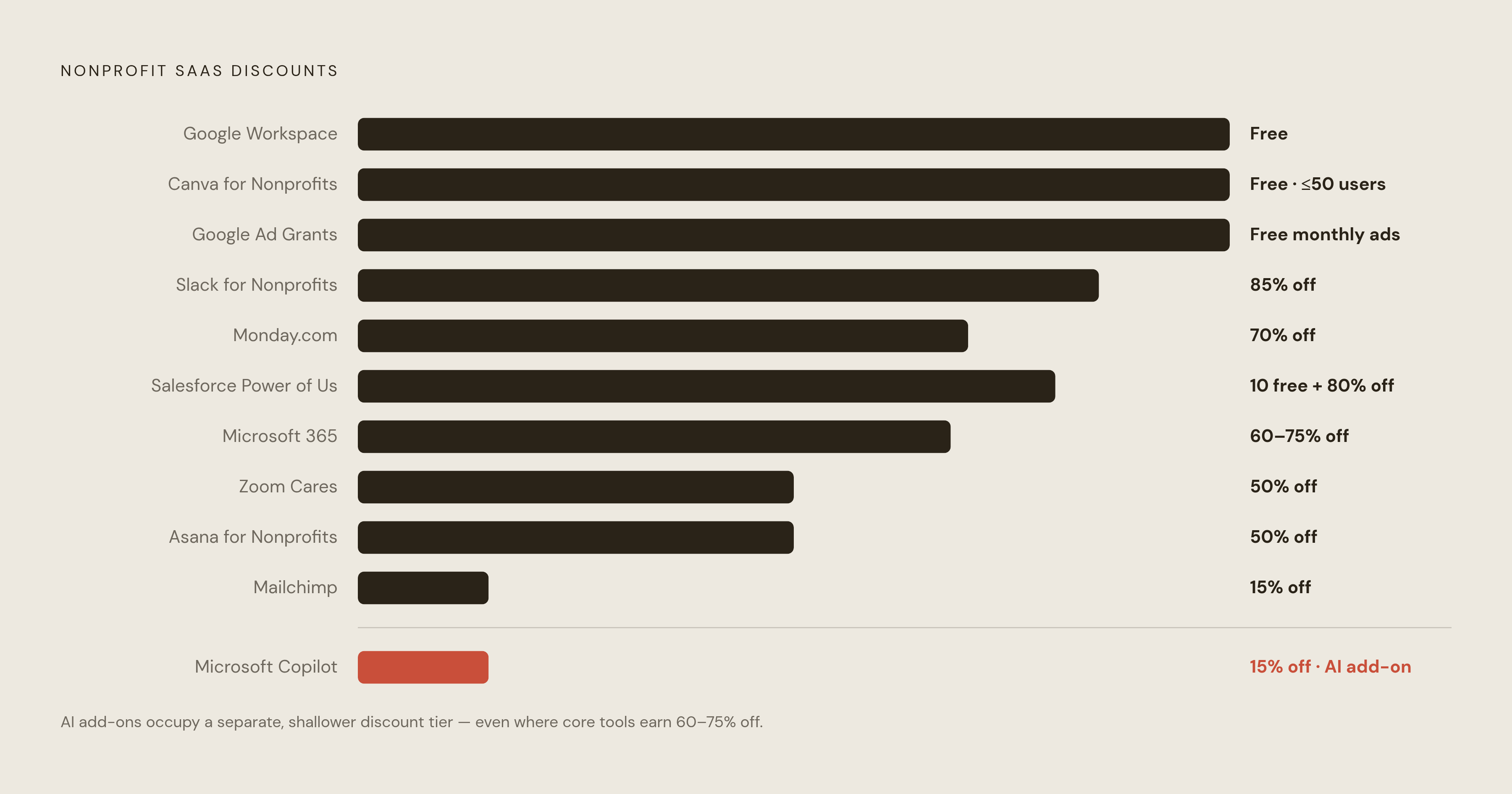
Microsoft raised nonprofit prices on July 1, 2026, in step with commercial increases across Business Standard, Microsoft 365 E3, E5, and F3. The price can still rise after an organization gets a discount. By contrast, Google for Nonprofits provides free Google Workspace access, including Gmail, Drive, Meet, Docs, Sheets, Slides, and Calendar. Its free offering now also includes Gemini and NotebookLM at no extra cost.
Slack for Nonprofits provides Pro free for smaller workspaces below its published member threshold and 85% off paid plans for larger organizations, with eligibility through TechSoup. Zoom Cares offers nonprofits 50% off Zoom Workplace Pro and Zoom Workplace Business if their annual operating budget is below its published limit. Goodstack checks who qualifies, and education institutions and healthcare organizations are left out. The percentage alone is not the full offer.
For CRM, Salesforce Power of Us Programme provides 10 free Enterprise Edition licenses and additional licenses at 80% off standard pricing. The programme has supported over 26,000 nonprofit organizations globally. Bloomerang has nonprofit pricing for its donor management tools, which include retention analytics and email tools. Zoho CRM also offers nonprofit pricing, but current rates and eligibility require a conversation with its sales team. Bundling email, HR, and finance tools across Zoho’s broader suite can increase savings.
Canva for Nonprofits provides free Canva Teams access for up to 50 users, including premium templates, brand kits, video editing, and collaboration features. Additional seats receive 50% off Canva Enterprise pricing. Google Ad Grants supplies a substantial monthly budget for free Google Search advertising through the same nonprofit account used for Workspace. Mailchimp offers 15% off for nonprofits registered with TechSoup, while Constant Contact also offers a nonprofit discount through that registration.
Project management has its own published starting points. Asana for Nonprofits offers 50% off Starter or Advanced annual plans, and Monday.com offers a set number of free seats, then 70% off any seats beyond that. Microsoft’s core nonprofit discounts reach 75%, with rates of 60–75% across the broader suite portfolio as of July 2026, but its Copilot add-on discount is just 15%. AI features need separate pricing and verified rates in the budget.
Why a 501(c)(3) determination letter is necessary but often not sufficient
A determination letter establishes status. Google explicitly excludes government entities, hospitals and healthcare organizations, and schools, with only narrow carve-outs. HubSpot limits its nonprofit discount to organizations registered in North America, Australia, or New Zealand. These restrictions make a short eligibility review more useful than starting every available application.
Other conditions concern who will use the software. Some programs have rules that limit access for political organizations or for-profit subsidiaries, and others offer discounted accounts only to staff in certain roles. Beneficiaries, members, and general donors may not be covered. Before it applies, an organization should check whether the program’s exclusions cover its type of organization or the people who will use the software. If excluded, it can look for alternatives or negotiate directly rather than treat one rejection as an ecosystem-wide answer.
Timing needs the same early attention as eligibility. Verification processes can take one to three weeks, although some platforms offer immediate approval to organizations already in their databases. That lead time belongs in budget and renewal planning. Waiting until a contract expires can leave too little room to resolve an eligibility question.
How to make the case for a better deal when the published program is the starting point, not the ceiling
For an eligible organization, the published rate is a starting point for negotiation. Alongside its 501(c)(3) status, the organization should lead with how its mission fits the vendor’s and what its budget allows. What makes the commercial price inaccessible, and what can the organization offer in return? Total seats, renewal history, referral potential, and willingness to provide a testimonial give the vendor something concrete to assess.
Long-term commitment can strengthen that case through a multi-year contract, reference willingness, or case study participation. Peer advocacy has value too. Nonprofit buyers often rely on recommendations through the Association of Fundraising Professionals, the Nonprofit Technology Network, and state nonprofit associations. Vendors that put serious work into selling to nonprofits know those networks. An organization willing to advocate in them can explain that contribution as a reason for a concession in the exchange.
A flat percentage can also hide differences in affordability. Smaller nonprofits often get the same percentage discount as much larger organizations, even though their budgets are far smaller. That creates a reason to ask about budget-tiered pricing. For software outside TechSoup’s catalog, its verification can support the discussion without requiring the vendor to establish a separate verification process.
If funding is tied to technology line items, explaining the award date and grant period can help a vendor hold pricing across quarters or offer a deferred start date. Major grant cycles can create receptive purchasing windows in the months immediately after award announcements. An organization whose grant period starts October 1 may be looking at technology in August–September, so that can be a good time to talk to vendors. The request becomes more persuasive when it explains when funding can actually support the purchase.
Even then, getting a vendor to agree to a bigger percentage discount may be hardest. Exceptions create precedent and administrative work, so vendors may be more flexible on contract length, implementation support, seat minimums, or feature-tier access. Salesforce, Microsoft, Google, and HubSpot have dedicated nonprofit teams or programs with formal approval paths for exceptions, while smaller vendors may decide at the account executive level. AI add-ons still warrant an explicit ask, but expectations should reflect their shallower published discounts.
The hidden cost of discount-chasing: when switching saves less than it seems
A cheaper subscription can still produce a more expensive change. Data migration, retraining staff, and rebuilding integrations take time that the quoted price leaves out. This burden grows when a tool is embedded in daily work, as CRMs, donor databases, and project management platforms often are. A small difference in discounts may not be worth the disruption to programs already running.
The decision therefore needs questions about work as well as price. Does the alternative require rebuilding integrations with the rest of the stack? Will staff need retraining, and is there capacity for it during program delivery? Does the replacement match the workflows the organization actually uses, rather than simply list similar features in a sales deck?
Caution is not the same as doing nothing. Zoom’s verification change illustrates how proactive re-validation avoids a service risk on an existing platform. The organization should weigh what it gains after switching costs alongside the size of the advertised discount. Sometimes the better result comes from negotiating harder with the incumbent.
Auditing what you already have before adding anything new
For most nonprofits, the fastest savings begin inside the existing stack. Idle seats on premium plans may remain after staff leave, while separate program teams accumulate overlapping survey tools, form builders, and communication platforms. Removing those costs requires an inventory of what is paid for and what is used.
Some tools remain on commercial rates because nobody claimed their programs, while other discounts lapse when annual re-verification is missed. In those cases, the organization may already have chosen the right tool but be paying the wrong rate. That is a different problem from needing a replacement.
A periodic audit should happen at least annually, timed to renewal cycles. Its purpose is to surface unused access, duplication, unclaimed discounts, and expired verification together. That gives negotiation a more accurate starting point. There is little value in securing a better rate for seats that should have been canceled.
When the tool itself is the right call and when the architecture underneath it needs attention
An audit can also reveal costs that subscription negotiations cannot fix. Airtable is accessible at 50% off through TechSoup, but using it for nonprofit operations can still require connecting payment processors, building donor databases from scratch, and managing multiple integrations. As programs grow, that engineering-dependent workflow can strain a small team. The tool’s price and its role are separate questions.
The right replacement depends on the role the tool needs to fill. Baserow is an open-source relational database available self-hosted or through managed cloud, with no user cap on its free self-hosted tier. Google Sheets supports real-time collaboration and is free within Workspace for Nonprofits. Notion takes a document-first approach and verifies nonprofit status in-house using submitted documents and public databases. Monday.com is another choice if its project management tools suit the work and the organization can afford its nonprofit plan.
Fundraising may call for a narrower tool instead. Zeffy has no platform fees, monthly charges, or transaction costs, with optional donor contributions supporting the platform so the nonprofit keeps every dollar donated. It is a fundraising-specific service that can eliminate a paid line item while serving a narrower role in internal workflows.
When donor portals, program management platforms, or volunteer systems outgrow a discounted stack, the next step should be an engineering assessment. That assessment should distinguish what can be patched from what needs rebuilding and address architecture and security risks. A technical partner who understands limited budgets and staff with multiple roles can continue development where possible. A discount can make technical debt affordable for a while, but it cannot replace a stable foundation.