Data Migration Plan for Startups Switching Backend Stacks
Gartner's research on data migration puts the failure and overrun rate at 83%. That's not a typo, and it's worth sitting with for a second before moving on. Most of those projects fail because nobody sequenced the work correctly, or because the plan assumed the easy 80% and got blindsided by the hard 20%, rather than because the engineers involved didn't know how to write a migration script.
That distinction matters more than it sounds like it should. If migrations failed because of technical difficulty, the fix would be hiring better engineers. The data says something else is going on.
When a startup actually needs to switch backend stacks
Early architectural compromises aren't mistakes. When you don't know if anyone wants your product yet, building on Firebase or wiring together Shopify and Zoho with a pile of custom scripts is the correct call. Speed matters more than elegance at that stage, and there's no shame in it.
But something shifts once real usage shows up. A database query that returned instantly against 500 test records starts taking three seconds against tens of thousands of real ones. A third-party API that felt snappy during the demo becomes the thing your users complain about on Twitter. A deploy that used to touch a handful of internal testers now touches thousands of paying customers, and a bad one means support tickets instead of a shrug.
This inflection point shows up in a few recognizable ways. BaaS platforms like Firebase or Supabase hit a ceiling, either on scale or on how much you can customize before you're fighting the platform instead of using it. Vendor lock-in starts limiting the product itself: exporting your own data becomes a project, costs climb as usage grows, and features you need simply aren't on the roadmap. Or you're running a Shopify and Zoho setup held together with thousand-line Lambda functions, the way Inventa was, about a year past their MVP. Inventa had genuine market fit. Customers liked the product. But the backend was accumulating incidents faster than the team could patch them, and every new feature meant another workaround stacked on the last one.
The shortcuts that got the MVP shipped, hardcoded configs, manual processes, error handling that assumes nothing ever goes wrong, don't stay harmless. They become liabilities exactly when real users start depending on the product every day. The stack looks this way because reasonable calls got made under uncertainty, and that's worth remembering before assigning blame. The better question is what a clean migration out of that stack actually looks like.
Auditing what you actually have before touching anything
Everything downstream of this phase depends on getting it right. Rushing the audit, or skipping pieces of it because "we already know our system," is the single most common source of mid-migration surprises.
A real audit covers a few things, and none of them are optional:
- Every data store you're running: the primary database, caches, queues, blob storage, any third-party datastore holding pieces of your product's data
- Schema documentation, written down now if it doesn't already exist, before any migration work starts
- Data volumes and growth rate: how much data exists, how fast it's growing, which tables get hit hardest
- Data quality: duplicates, null fields, inconsistent formats, orphaned records. Messy data is the biggest hurdle for most organizations attempting this kind of move, and it needs cleaning before migration, not after
- Every application dependency: each service, API endpoint, background job, and integration reading from or writing to the current backend
- Implicit contracts: the undocumented behaviors other systems quietly rely on, like field ordering, how nulls get handled, or the exact shape of a response
Schema debt deserves its own callout here, separate from the general audit. It's infrastructure-level debt: it touches every query, every endpoint, every report your team runs. Migrating a high-traffic production schema without downtime is one of the more expensive engineering operations a startup can take on, and pretending otherwise is how timelines blow up.
The output of this phase is two documents: a dependency map and a data inventory. Everything that happens in the phases after this gets decided by referencing those two documents, not by memory or assumption.
If your team doesn't have documentation because nobody ever wrote it, instrumentation and query log analysis can reconstruct what the system is actually doing. That's often different from what the team believes it's doing, and the gap between those two things is exactly where migrations go wrong later.
Mapping old schema to new and making explicit decisions about what changes
Schema mapping isn't a renaming exercise. It's the point where you're forced to make explicit, deliberate decisions about structural changes the new stack either enables or requires.
For each entity in your system, the mapping document needs to capture the source table or collection and where it lands in the new system, field-by-field type conversions along with anything that's lossy in the conversion, and how relationships translate. Foreign keys, join patterns, anything denormalized in the old schema that's getting normalized in the new one (or the reverse) all need to be spelled out. And you need an explicit list of records that won't migrate at all: deprecated data, soft-deleted rows, old test records. These should be decisions your team made on purpose, not things that quietly didn't make the cut.
Write the transformation logic down before it becomes code. Transformation rules that live only inside a migration script are a debugging problem waiting to happen six months from now, when nobody remembers why a particular field gets multiplied by 100 during the move.
Accumulated schema debt tends to mean the new schema looks meaningfully different from the old one. That's a real opportunity to clean things up, but it also multiplies how complex the transformation logic gets. Resist trying to fix everything in the same pass. Separate "parity migration," moving what exists as-is, from "improvement migration," changing how something works along the way. Mixing those two categories without labeling them is how scope quietly balloons.
Define what "correctly migrated" means for each entity before any migration code gets written. That definition becomes your test suite later, during validation. And whoever owns the product, not just the engineers, needs a seat at this table. Deciding what data gets kept, what changes shape, and what gets deprecated has business consequences that shouldn't be made unilaterally by whoever's writing the migration script.
Choosing a migration strategy that fits a live product
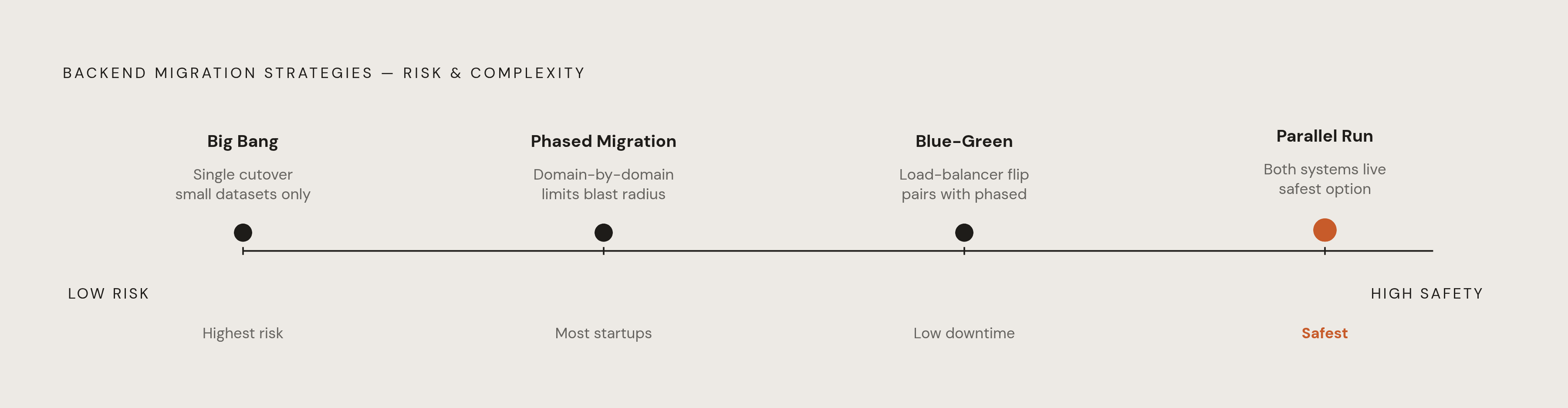
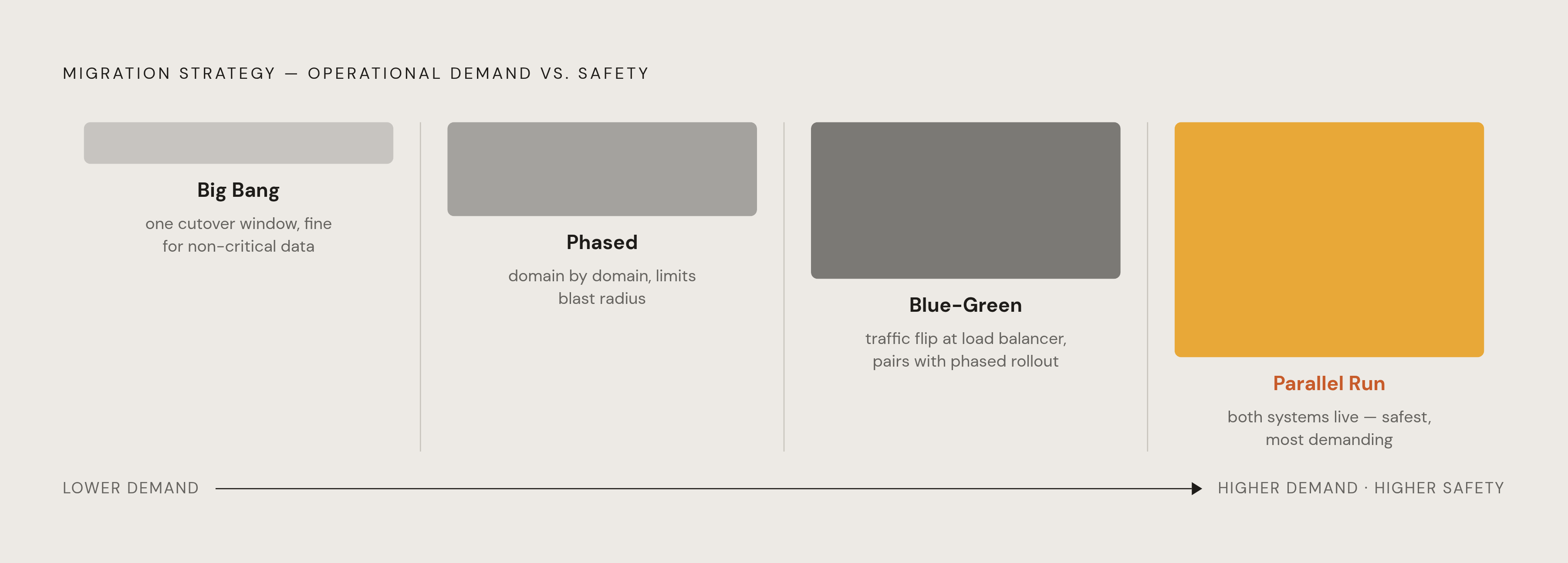
There are four real strategies here, and they're not interchangeable.
Big bang migration moves everything in one cutover window. It's fine for small, non-critical datasets where downtime doesn't hurt anyone. For a live product with paying users, it carries too much risk. Phased migration moves data and traffic domain by domain, and it's the preferred approach for most startups because it limits how much damage any single mistake can do. Parallel run keeps both the old and new systems live and receiving writes at the same time; it's the safest option and the most operationally demanding, appropriate when the cost of getting data wrong is severe. Blue-green deployment cuts traffic over at the load balancer level, which minimizes downtime at the moment of cutover and pairs well with a phased rollout.
Here's a number worth sitting on: according to Medha Cloud, organizations that pilot 5 to 10% of their workloads before the full migration cut their overall migration time by 28%. That's the case for starting small, concretely.
What should that pilot actually be? The least critical, lowest-traffic domain you have. It proves out your tooling, exposes gaps in the mapping document you thought was complete, and builds team confidence before anyone touches data that a real user is looking at right now.
For most startups, phased migration paired with blue-green cutover is the combination that lets production keep running while still giving you a real validation window at each phase boundary. Whatever strategy you land on, document it and get agreement before any infrastructure gets provisioned. Switching strategy mid-migration adds exactly the kind of unplanned complexity that drives projects past their budgets and timelines.
Running old and new backends in parallel without corrupting data
The dual-write period, when both backends are live and have to stay in sync, is the riskiest stretch of the entire migration. This is where data corruption actually happens, if it's going to happen.
Write to the old backend first, then replicate asynchronously to the new one. The old backend stays the source of truth right up until cutover is finished; nothing flips that until you say so. Queue-based replication is safer than synchronous dual-writes, since synchronous writes introduce latency and create partial-write failure modes you don't want to debug live. Define an acceptable replication lag threshold and alert the moment you breach it, before lag turns into actual divergence between the two systems.
Feature flags do the traffic control work here. They let you cut over per feature and per user segment instead of flipping everything at once, and they let you roll back a single flow instantly without unwinding the whole migration. For a phased strategy, each phase boundary should be a flag flip, not a full deployment event.
During the parallel window, keep an eye on write consistency between the two backends using record counts and checksums on the tables that matter most. Watch read latency on the new backend under actual production traffic, not synthetic benchmark load, since those numbers rarely match. Track error rates on the new backend broken out by endpoint, and watch replication queue depth closely: a queue that's growing is an early warning sign, arriving before data divergence actually shows up.
None of this works without a rollback plan defined before the parallel window opens, not after. The exact trigger conditions, the exact steps, all written down in advance. Teams that write the rollback plan after something's already broken are, by definition, too late to use it.
Inventa's migration is a useful reference point here. The eventual outcome was a stable product, fewer incidents, and a system architecture the team could actually reason about. Getting there meant rebuilding entire workflows from the ground up rather than patching what already existed. That's often the honest tradeoff.
Validating data integrity before flipping the cutover switch
Validation isn't a step you run once at the end. It runs continuously, starting with the first pilot migration and continuing right up through the cutover decision itself.
Every migrated record needs to answer three questions. Is it complete: is every record that should have migrated actually present in the new system? Is it accurate: are the field values correct, including anything that went through a type conversion or transformation? And is it consistent: are relationships intact, with no orphaned foreign keys or broken references sitting around waiting to surface as a bug three weeks later?
Row count and checksum comparisons across the two backends are fast and catch bulk errors quickly. Automated diff tooling on sampled records catches field-level errors that simple counts miss entirely. Shadow reads, where a sample of production reads gets routed to both backends and the responses compared, catch application-layer transformation bugs that data-layer checks alone won't surface.
Beyond the data itself, run your actual application workflows against the new backend and compare the outputs. This is where bugs hide that pass every data-layer check but still produce the wrong behavior once a user actually clicks the button.
Before the parallel window even opens, define binary go or no-go criteria for cutover: a record count variance threshold, an error rate ceiling, a latency ceiling. When cutover day arrives, the decision gets made against those criteria, not against whatever's on the calendar. And document every discrepancy you find during validation. A discrepancy caught and fixed before cutover is evidence your migration is ready. The same discrepancy found after cutover is an incident.
Executing the cutover with minimum disruption to live users
Timing matters here more than it might seem. Pick the lowest-traffic window your usage data actually supports; for B2B tools this is often mid-week overnight, while consumer products vary by geography and behavior pattern, so don't assume your window looks like someone else's.
The sequence itself follows a clear order: stop writes to the old backend, or set it to read-only. Run a final incremental sync to close whatever replication gap remains. Verify that final sync against the validation criteria you already defined. Flip DNS, load balancer, or feature flags over to the new backend. Then monitor error rates and latency in real time, and keep watching for the first hour, not just the first five minutes, since some failure modes take longer than that to surface.
With blue-green mechanics, the old environment stays live and idle for a defined hold period; it doesn't get decommissioned the moment cutover happens. That way, rollback is a traffic flip you can execute in seconds, not a data restore that takes hours.
Internal teams need to know the cutover window and the rollback trigger before it happens, especially support and customer success, since they're the ones fielding calls if something goes sideways. Whether you communicate the cutover to users directly depends on the scope of what's changing, but support should expect elevated contact volume regardless.
Success right after cutover looks unremarkable, which is the point: error rates at or below where they were before migration, latency at or below baseline, no reads coming back with unexpected nulls or records that seem to have vanished. And decommissioning the old backend is a separate decision from cutover itself. Hold onto it until the new backend has run under real production load for a defined stabilization period.
Post-cutover monitoring and the ongoing work after the migration is "done"
The week right after cutover is not the moment to ease off monitoring. If anything, it's the highest-risk window for edge-case failures that only show up once real usage patterns start hitting the new system in ways your testing never quite replicated.
For the first 30 days, watch slow query logs on the new backend closely; queries that looked fine in testing often behave differently once real access patterns show up. Track storage growth against what you projected, since unexpected growth is often a sign of untransformed data or old logging behavior that carried over from the previous stack without anyone noticing. And take user-reported data issues seriously. Support tickets are a lagging signal, but they're a real one, often catching migration bugs that every automated check missed.
Whatever technical debt got deferred during the mapping phase, the "parity migration" items you set aside from the "improvement migration" ones, needs to stay tracked rather than forgotten the moment cutover succeeds. Many teams set aside something like 20 to 30% of each sprint after a major migration specifically to work through that accumulated debt, which keeps the new stack from quietly building up its own version of the same problem within a year.
The real measure of whether a migration worked shows up six months later, in what the product can do that it couldn't do before: features that ship faster, incidents that don't happen anymore, room to scale that didn't exist under the old stack. For founders without an internal engineering team to carry that ongoing work, the plan doesn't end at cutover. Whoever rebuilt the system needs to stay through stabilization and into ongoing maintenance, because the patterns that show up in month two matter just as much as the ones caught during testing, and often more.