Communicating Technical Debt to Non-Technical Founders
Most technical debt conversations fail for a structural reason: engineers describe the state of the code, and founders think in customers, runway, and growth. When an engineer says "we need to refactor the service layer" or "the architecture is getting messy," a founder often hears something closer to "we'd like to make the code prettier." That gap is the whole problem: whose fault is this, really? Neither party is being unreasonable. They're using two different operating languages for the same underlying risk.
The irony is that this exact failure was anticipated more than three decades ago. Ward Cunningham introduced the term "technical debt" in a 1992 OOPSLA report, and he built the metaphor specifically so engineers could explain rework to business stakeholders in terms they'd already understand: borrowing, interest, repayment. The metaphor was a translation device from day one. Yet the conversation still collapses, over and over, in nearly the same pattern: an engineer raises the issue, says some version of "trust us, it's bad," and leadership asks for one more feature first. The debt gets logged somewhere, usually a spreadsheet, and that spreadsheet goes stale within weeks because nobody owns updating it.
This keeps happening because the dynamic is structural, not personal. A founder who needs technology leadership often ends up buying development capacity instead, and those are not interchangeable things. Development capacity ships features. Technology leadership tells you what those features are going to cost you later, and in what currency. Until a founder has a way to hear that second message, the conversation will keep sounding like engineers asking for permission to tidy up, rather than what it actually is: a warning about future cost.
What technical debt is, in terms a founder already uses
Technical debt works like a loan. A team borrows against future development capacity to ship something faster today, and that loan carries interest: a little more time, a little more friction, on every piece of work that touches the same code afterward. The shortcut taken today is the principal. The extra effort every subsequent change requires because of that shortcut is the interest, and it compounds. Skip a payment (meaning skip the refactor) and the interest keeps accruing on top of itself.
None of this makes debt a sign of bad engineering. An MVP built for speed is supposed to carry some debt. Taking a shortcut to get a product in front of real customers faster was very likely the right call at the time, and judging it after the fact as sloppy work misses the point of what an MVP is for.
What matters more is that not all debt behaves the same way, and treating it as one undifferentiated pile is where a lot of founders go wrong. Martin Fowler's Technical Debt Quadrant sorts debt along two axes: deliberate versus inadvertent, and prudent versus reckless. That distinction should change what a founder actually does about it.
Debt that's prudent and deliberate (the team knew the shortcut, chose it on purpose, and said "we'll deal with the consequences later") was a rational trade. It just needs a scheduled payoff, the same way a founder would schedule a loan repayment. Debt that's reckless, taken on without anyone realizing it was debt at all, is harder to spot and more expensive to carry, because nobody flagged the loan when it was issued. And some debt, sitting in code nobody touches often, genuinely isn't worth paying down. The interest on it is negligible. Recognizing that is what separates managing debt from moralizing about it.
A founder will run into several flavors of this in practice: code debt (duplication and needless complexity), architecture debt (systems too tightly coupled to change independently), test debt (no automated checks, so every release is a guess), documentation debt (critical logic that lives only in one engineer's head), and dependency debt (outdated libraries carrying known security gaps). Each one accrues interest differently, and each one calls for a different kind of payment plan.
When technical debt starts costing founders money
The dangerous moment is when real users show up and the product starts scaling, because that's when the interest payments on earlier shortcuts turn into visible business costs: slower releases, more bugs, unhappier customers.
The expensive mistake founders make here is continuing to stack new features on code that was only ever meant to survive the first sprint. What was a smart shortcut at launch becomes a compounding tax on every feature that follows. "Refactor later" keeps slipping, quarter after quarter, because product work always wins the argument for priority. But postponing the refactor doesn't freeze the cost. It raises it, because more features keep piling onto the same shaky structure, and untangling that structure gets more expensive the longer it's deferred.
This dynamic isn't hypothetical, and it isn't limited to small startups. A major airline's well-documented scheduling system collapse is a useful reference point for what happens when deferred technical debt finally reaches its breaking point at scale: a system built for a different era of operations couldn't absorb the pressure it was eventually put under. The specifics of that case are particular to an airline, but the shape of the failure, deferred debt meeting a moment of real stress, repeats at every size of company.
For a founder heading toward a fundraising round, unchecked debt is a strategic risk before it's anything else. It erodes engineering velocity, inflates the cost of maintenance, and stalls new feature development, all of which investors read directly as capital inefficiency. Hiring suffers too: an engineer who joins a startup with a tangled codebase spends the first months untangling old decisions instead of learning the product, and that's a fast way to lose people who came in expecting to build.
Security exposure moves the same direction. Outdated dependencies and missing documentation raise compliance risk, and a high-debt system can carry cybersecurity weaknesses that take far longer to fix than a founder expects. One broken checkout flow or failed login can lose a customer permanently. Reliability at this stage is a growth lever, as real as acquisition spend or conversion rate.
This inflection point, where shortcuts stop being a development preference and start being a business risk, is often where founders discover the real difference between getting a product to launch and keeping it reliably alive under real usage. That shift changes what "reliability" even means for the business, and it's one reason product engineering partners who work specifically on rebuilding MVPs built under launch pressure spend so much time upfront diagnosing exactly where that line sits for a given codebase.
Hearing What an Engineer Is Really Telling You
A founder does not need to read code to engage meaningfully in this conversation. The right questions translate engineering symptoms into business terms almost immediately, no technical background required.
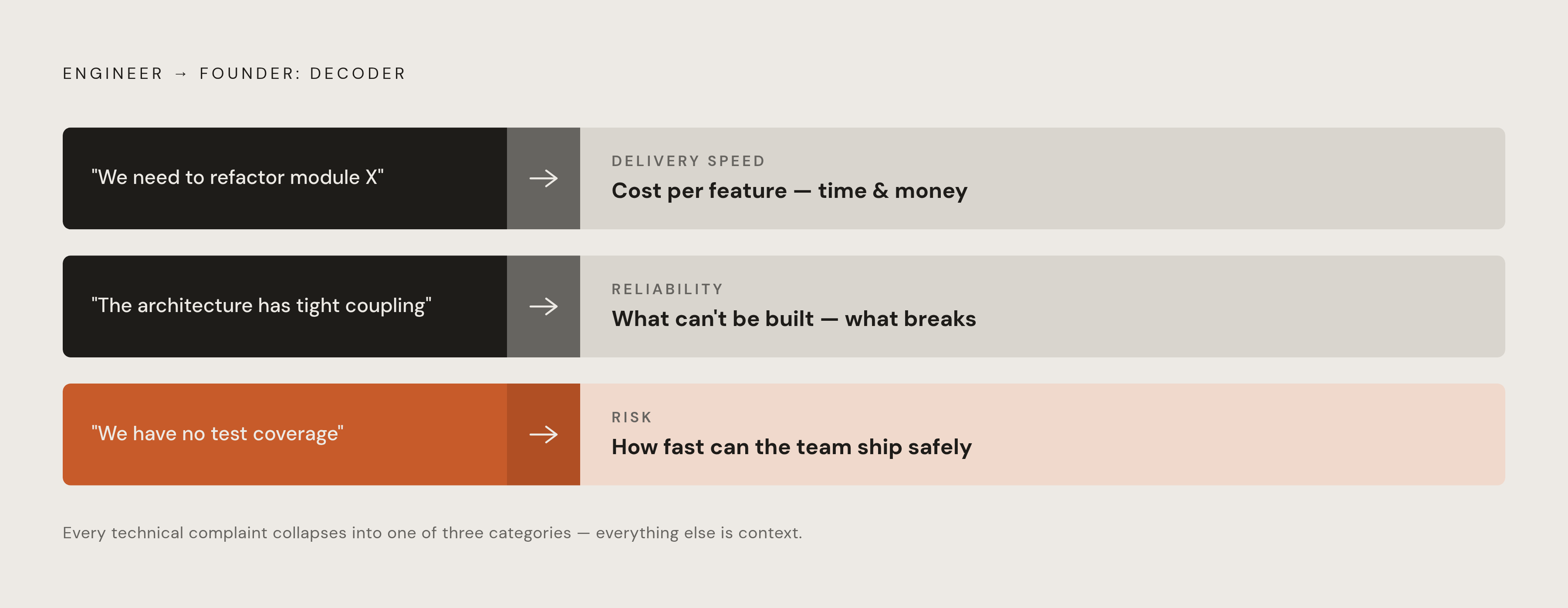
When an engineer says "we need to refactor module X," the useful question back is: what does it cost, in time or money, to leave it alone right now, on the next feature? That single question moves the conversation from housekeeping to return on investment.
When an engineer says "the architecture has tight coupling," the useful question is: what can't we build because of this, or what breaks when we try? Coupling is a hard constraint on the product roadmap, and it deserves to be treated as one.
When an engineer says "we have no test coverage," the useful question is: what does that mean for how fast the team can ship safely, and what's the actual risk in deploying a change? Test debt is a speed problem and a reliability problem bundled together, not a box to check off later.
Notice the pattern. Every technical complaint, no matter how it's phrased, maps back to one of three founder concerns: delivery speed, reliability, or risk. Asking which of the three is in play turns a vague complaint into something a founder can actually act on.
Asking an engineering partner or lead to explain architecture decisions, risks, and tradeoffs in plain language tied to the actual product is how decisions get made without guessing, and it's functionally part of the engineering work itself. An engineer or outside vendor who can't connect a technical recommendation to a business outcome is either not thinking about the business side of the decision or struggling to communicate it, and either one is worth more questions before a founder defers to their judgment.
Framing Technical Debt for Your Board, Co-Founder, or Investors
Framing debt as a business cost with a concrete return is the only approach that reliably wins a budget conversation. "Trust us, it's bad" has never been enough to unlock engineering time, and it won't start working now.
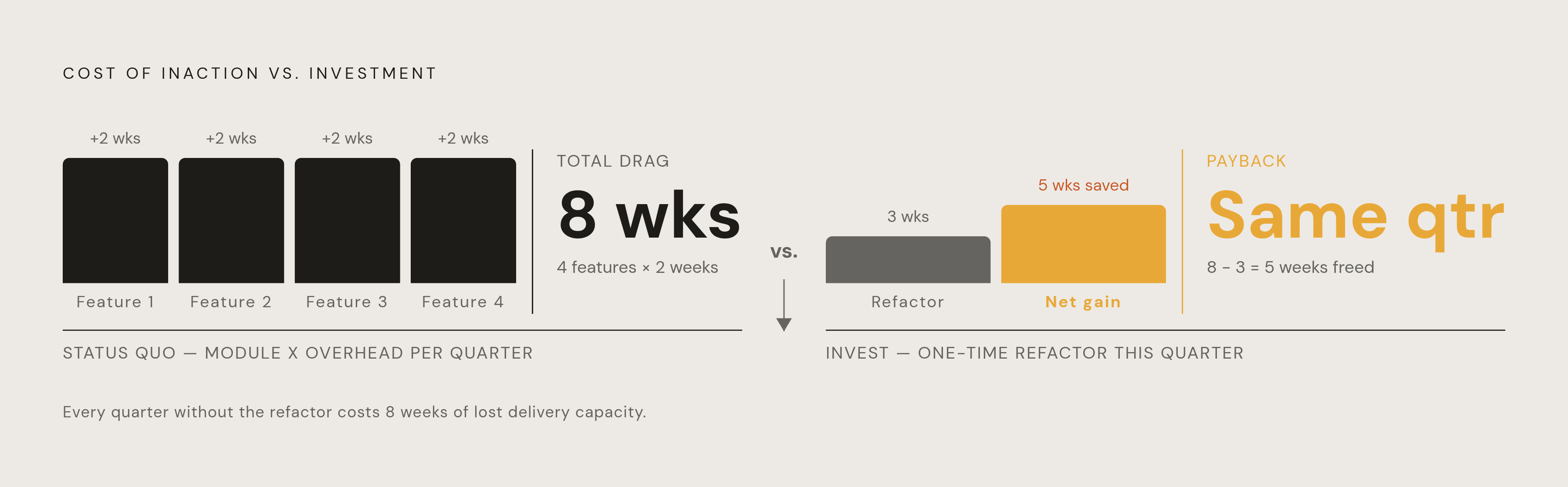
The translation formula is simple enough to use in the next meeting: state the current cost per unit of work, multiply it by the work planned this quarter, then show the investment required to eliminate that cost and how fast it pays back. One practitioner framing lays this out cleanly: "Every new feature in the payments area costs us an extra two weeks due to problems with module X. This quarter we're planning four payment features, that's eight weeks lost. A three-week investment in refactoring pays off in the same quarter." That's a budget pitch a board can approve in five minutes, because it's built entirely out of numbers they already know how to evaluate.
Positioning matters as much as the math. Debt framed as investment has a return attached to it. Debt framed as housekeeping reads as an expense, something to defer. The exact same piece of engineering work can win or lose a budget discussion depending entirely on which of those two frames it arrives in.
Tools exist that turn this from estimation into a defensible number. The SQALE model, used in SonarQube, converts code issues into estimated repair time, which gives a founder a concrete figure: this debt represents roughly this many days of work. A number like that invites rational prioritization instead of asking a board to simply defer to engineering judgment on faith.
Practitioners generally recommend setting aside a standing portion of every sprint for debt reduction and treating that time as non-negotiable, the same way a loan payment isn't optional. A standing budget, applied consistently, prevents the re-accumulation that a single big cleanup quarter never fixes for long.
For investor conversations specifically, debt translates cleanly into a metric they already track: capital efficiency. Engineering hours consumed by maintenance instead of new progress shorten runway, which lowers the burn rate figures a board is already watching. Framed that way, a request to pay down debt is a runway conversation.
Where technical debt hides in nonprofit and mission-driven organizations
Nonprofits carry the same technical debt as any startup, but they carry it under a structural disadvantage: technology tends to get classified as overhead. That classification alone makes the debt conversation harder to have, because the spending has to compete against program budgets.
When technology is treated as overhead, debt goes unnamed until it causes a visible crisis, rather than being tracked as a known, managed liability the way a healthy engineering team would track it. A common pattern in these organizations is the hero admin: one person holds most of the system's logic, history, and structure in their head, because documentation was never a budget priority. When that person leaves, the organization loses institutional knowledge that no manual or wiki ever captured. That's documentation debt and architecture debt wearing a human face.
Staff turnover makes this worse, not better, over time. Organizations that have grown past their original systems often can't even describe the gap between where they are and where their tools are, because the people who built those original systems left years earlier.
The real cost of this debt in a nonprofit is a hidden tax on the mission itself. Every manual workaround, every spreadsheet duplicating a database that should exist, every slow internal workflow consumes staff time and capacity that could otherwise go toward serving the people the organization exists to serve, or toward demonstrating results to the donors funding that work. A workaround that quietly consumes the equivalent of two full-time staff positions a year is direct service capacity the mission never gets back.
The framing that actually works in a nonprofit board meeting isn't "we need to modernize our systems." It's something closer to "this workaround costs us a measurable number of staff hours a month that could be direct service time instead." Mission impact is the currency a nonprofit board understands, the same way runway is the currency a startup board understands. The argument is identical in structure. Only the unit of account changes.
What to check before signing with a technical partner
Choosing a technical partner is where everything in this article pays off directly, because the wrong partner can load debt into a product before a single line of it reaches production. A founder's assessment should cover three things before signing: how the partner explains architecture decisions in plain language, whether they stay engaged past initial delivery or hand off and disappear, and whether they can name the tradeoffs and fallback options for the choices they're making on the founder's behalf.
A familiar cautionary pattern plays out when a project-based shop delivers code that technically works, then leaves. The client's in-house engineers can't extend it. Documentation is thin or nonexistent. Modules are coupled so tightly that one change ripples unpredictably through the rest of the system. The software was delivered. Operationally, it's a liability the founder now owns alone.
The test a non-technical founder can actually run here doesn't require reading code. Ask the partner to walk through their architecture choices, the risks they see in the approach, and their fallback plan, using language tied to the product. If they can't do that, the communication gap a founder is trying to avoid will persist through the entire engagement, not just the sales conversation.
A long-term technical partner looks different from a project shop in a specific, checkable way: they stay on through production, they own the engineering problems so the founder can focus on go-to-market and client acquisition, and they treat reliability as a growth lever rather than a line item they hand off and walk away from. Quwa Labs operates on that model, rebuilding products on more solid technical foundations and staying engaged through an ongoing maintenance plan rather than exiting at delivery, functioning less like a vendor and more like a technical partner a founder can keep growing with.
That's the real test of a partner before signing anything: not whether they can ship a working demo, but whether they can explain, honestly and in plain terms, what debt the product will carry six months after launch, and who's still in the room to help pay it down.